
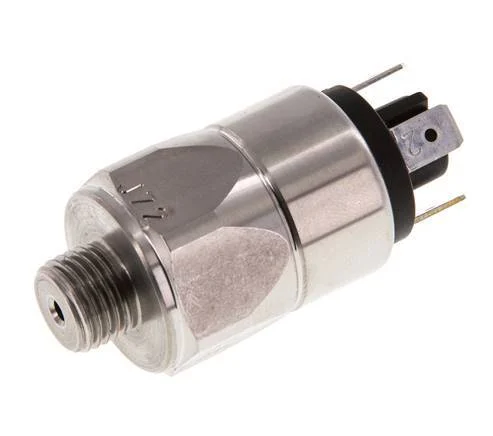
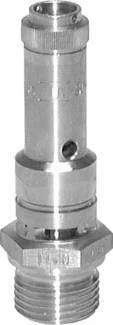
This is a mechanical pressure switch with changeover (SPDT (single pole, double throw)) contacts. They are composed of a normally closed contact pair and a normally open contact pair. The setpoint is the pressure value where the switch activates and the reset point is the value at which the switch deactivates when the pressure decreases. The setpoint can be adjusted between 10 and 50 bar (145 and 725 psi). The maximum overpressure is 300 bar (4351 psi). It has a switch hysteresis (the difference between setpoint and reset point) of 15 – 30%. The switching capacity for this pressure switch is 4 A @ 250 V AC or 4 A @ 30 V DC. It can be connected to an electrical network with a flat connector. This pressure switch is made in a diaphragm design with a stainless steel body and a EPDM seal. It is suitable for various media, such as compressed air and in a temperature range from -30 to 120°C (from -22 to 248°F). The connection port has a size of G 1/4 inch with male threads. The pressure switch has an IP65 rating.
Pros:
- A mechanical pressure switch doesn’t need a power supply
- Long working life and stable operation
Cons:
- The accuracy of mechanical pressure switches is lower than that of electronic pressure switches
- Electronic pressure switches are better suited for process control where several switch points, the stability and flexibility of the control are important
PSL series
Tameson offers a wide range of mechanical and electronic pressure switches. The mechanical pressure switches are available with three different types of contacts: normally open (NO), normally closed (NC) and changeover contacts. The setting pressure is typically adjusted with a hex key or turning knob. The electronic pressure switches have a digital display to set up the switching function. Electronic switches often combine the function of a pressure transducer with a 0-10 V, 4-20 mA or digital output signal. The setting pressure range for these pressure switches is from -1 to 600 bar (from -14 to 8702 psi) and overpressure safety of up to 600 bar (8702 psi) can be attained. Hysteresis is the difference between the switch point and the reset point. Mechanical switches have a hysteresis in the range of 10-30% while electronic switches are often configurable. Choose from a wide range of switch capacities. Please note that maximum load is dependent on voltage and different loads are allowed for AC or DC voltage. Electronic pressure switches require power supply to function. Choose from brass, steel or stainless steel options with various sealing materials to be compatible with your medium and temperatures. Check our chemical resistance table when in doubt. Furthermore, choose from a wide range of options such as mounting standards, electrical connections, ATEX approvals and more.
Specifications
Connection size : 1/4 inch
Material : Stainless steel
Seal material : EPDM
Contacts : Changeover contact
Max. overpressure (bar) : 300
Max switch capacity : 4 A / 250 V AC,4 A / 30 V DC
Switch hysteresis : 15 – 30 percent
Max pressure (bar) : 50
Min pressure (bar) : 10
Connection type : Outer thread cylindrical BSPP-G
Quality of material : Stainless steel 303 (1.4305)
Min temperature (°C) : -30
Max temperature (°C) : 120
Electrical connection : Flat plug-in connection
Degree of protection (IP) : IP65
Suitable for ammonia : No
Suitable for air : Yes
Suitable for oil : No
Suitable for water : Yes
Suitable for steam : No
Suitable for gases : Yes
Suitable for glycol : No
Measuring element : Membrane
Reviews
There are no reviews yet.